

Newborn Screening Abraded Blood Collection
The abbreviation "AB" is used by the Bureau of Clinical Laboratories Newborn Screening Laboratory for submitted specimens that are abraded. If the specimen is rejected due to "Abraded," another specimen must be collected. This delays the screening process, causes additional stress to the baby and parents, and most importantly, slows the possible detection of a life-threatening disorder.
Steps to Collecting a Satisfactory Newborn Screen
- Puncture the heel with a disposable lancet deep enough to reach the skin’s primary blood supply, yet shallow enough to prevent heel or bone injury.
- Apply 5 large (approximately 0.1 cc) drops of blood evenly to the filter paper printed circles.
- Do not remove the filter paper until the blood has completely soaked through to the other side.
- Specimens should be dried in a horizontal position for at least 4 hours.
Click the image below to enlarge it.
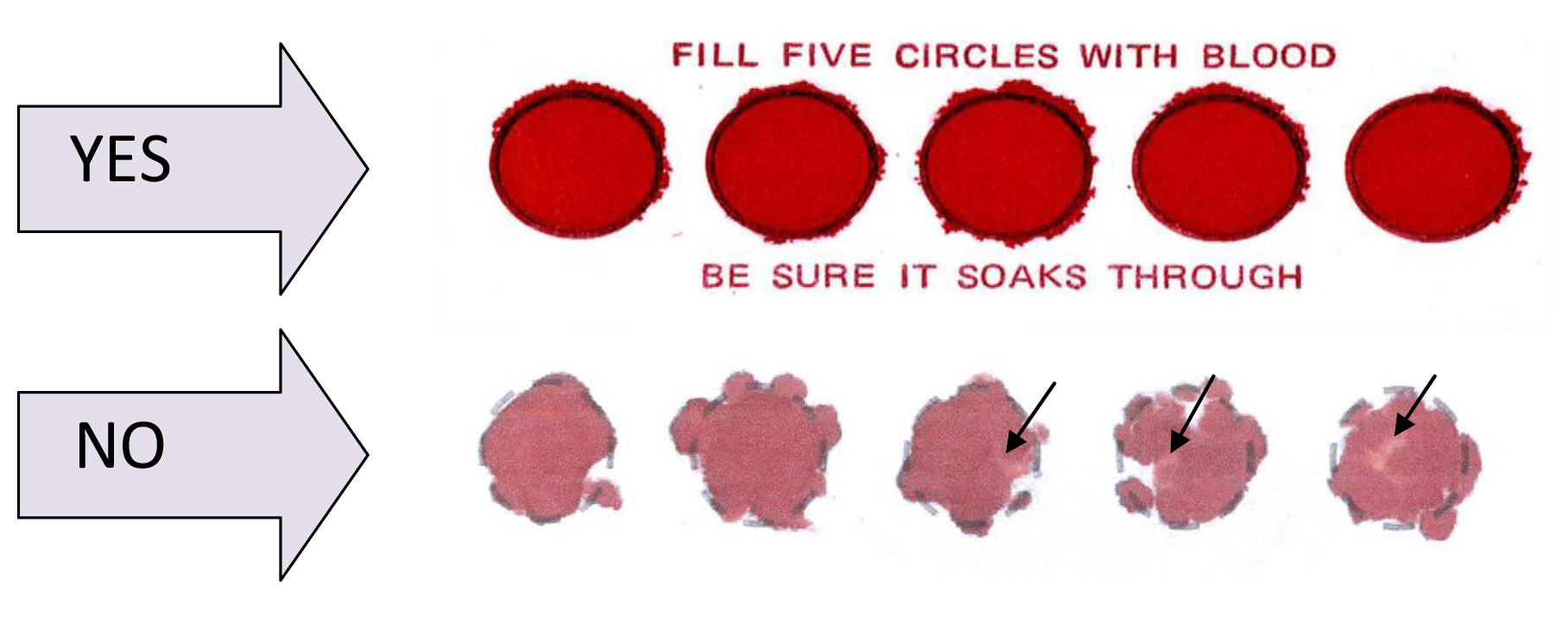
If a syringe, capillary tube, or other devise is used to collect the blood, they can scrape against the paper
and rough it up. Also, the paper may become abraded if the newborn’s heel rubs against it during the
collection process.
and rough it up. Also, the paper may become abraded if the newborn’s heel rubs against it during the
collection process.
The integrity of the paper is essential because portions of the paper are “punched” out and processed
by the Newborn Screening Laboratory for each test. If the filter paper is compromised, it can cause
uneven analyte concentrations or may not react to the laboratory reagents appropriately.
by the Newborn Screening Laboratory for each test. If the filter paper is compromised, it can cause
uneven analyte concentrations or may not react to the laboratory reagents appropriately.
Improper handling of the filter paper after collection, folding the flap over the collection area before the
specimen is completely dry, or sending the specimen through “metered” mail where it is stamped by a
machine may all lead to abrasion of the filter paper.
specimen is completely dry, or sending the specimen through “metered” mail where it is stamped by a
machine may all lead to abrasion of the filter paper.
Page last updated: July 17, 2026


