

Emergency Medical Stroke Assessment
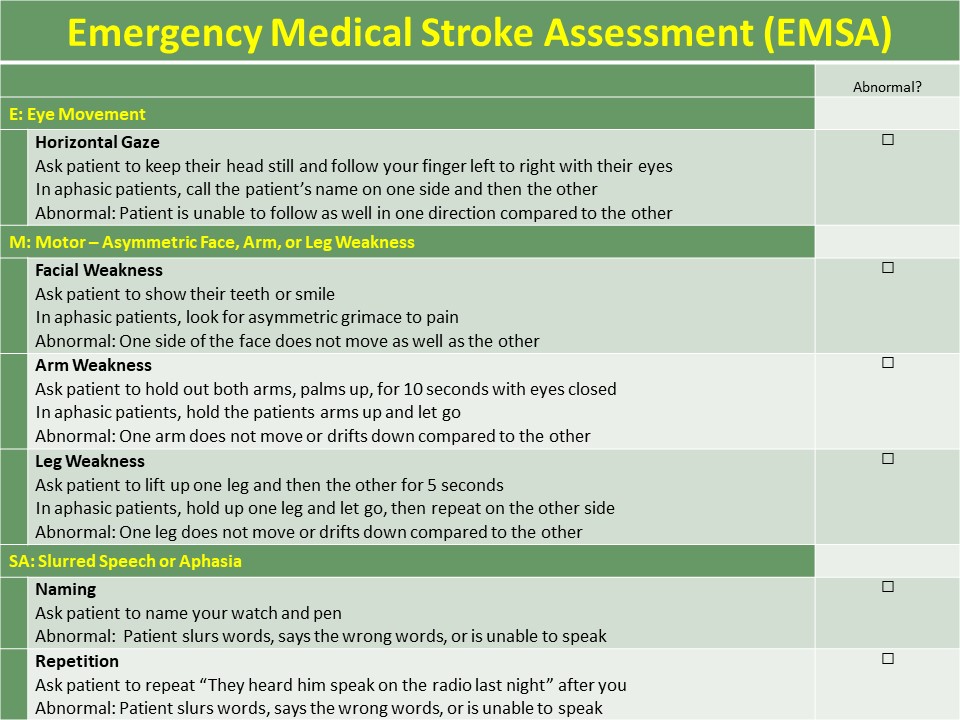
Emergency Medical Stroke Assessment (EMSA)
The intent of this web page is to provide information on recent and upcoming changes in the Alabama Statewide Stroke System. While two online training sessions were held in March, 2022, we realized that more information would need to be available for those who were unable to participate.
Overview
This video provides an overview of each section and specific information on time frames and needed documentation.
Alice B. Floyd, BSN, RN, EMT-P
Acute Health Systems Manager
Stroke System Update
Dr. Elwin Crawford will discuss recent challenges that stroke centers have faced, the Stroke System Rules that went into effect on March 17, 2022, and changes to the EMS Patient Care Protocols related to stroke assessment.
- Challenges for stroke centers
- EMS stroke assessment and rules change
- Stroke rules changes
Elwin Crawford, MD, FACEP, NRP
State EMS Medical Director
EMSA
Dr. Toby Gropen will introduce the Emergency Medical Stroke Assessment (EMSA), including demonstrations of the EMSA conducted by EMS personnel. He also provides information on the Next Steps for the Stroke System as Severity-Based Stroke Triage is implemented statewide.
Toby Gropen, MD, FAHA
Director, Comprehensive Neurovascular and Stroke Center at UAB
REDCap Data Entry Video
Stroke System Routing
Effective April 29, 2022 the Alabama EMS Patient Care Protocols 10th Edition went into effect, EMSP are required to use the Emergency Medical Stroke Assessment (EMSA) which will replace FAST. EMSA is a Severity Based Stroke Triage tool which screens for stroke and helps identify Large Vessel Occlusion (LVO) a severe form of stroke.
Patients entered in the stroke system without indications of an LVO (EMSA <4) will be routed to the closest available stroke center. Patients entered into the stroke system that indicate a potential LVO (EMSA of 4 or greater) will be transported to the closest available Level IIa or Level I stroke center if travel time is less than 60 minutes and the LKW time is less than 3.5 hours; if transport time is greater than 60 minutes or LKW is greater than 3.5 hours, the patient will be routed to the closest appropriate and available stroke center.
If the patient is unstable and cannot be effectively ventilated by the EMSP, the patient should be transported to the closest hospital with full time emergency physician coverage as coordinated by the ATCC.
In a situation where ATCC notification has occurred and no medical direction is needed, the ATCC will notify the receiving hospital of the patient transport and provide information of condition, estimated arrival time, etc.
Michael Minor, BBA, NRP
Executive Director, Alabama Trauma Communication Center
EMSA Card
Page last updated: October 23, 2026


