
Font Size:

Breastfeeding

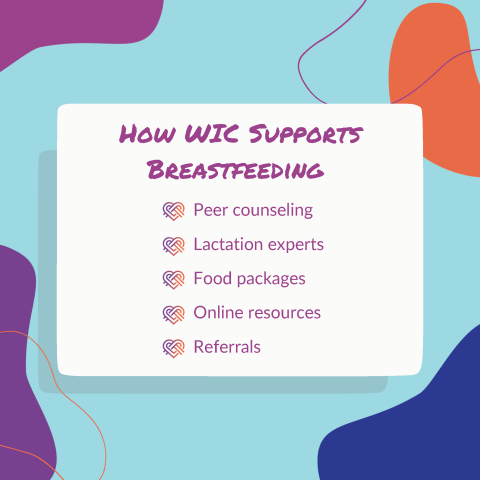
How WIC Supports Breastfeeding (Checklist)Breastfeeding is one of the best gifts you can give your baby. It provides important health, nutritional, emotional, and economic benefits. Breastfed babies have lower risks of asthma, infections, allergies, obesity, and heart disease. Mothers who breastfeed for at least six months reduce their risk of Type 2 diabetes, breast and ovarian cancers, with greater protection the longer they breastfeed.

Healthy People 2030 aims to improve infant health by increasing breastfeeding through 6 months and throughout the first year.

WIC Supports Breastfeeding

image of the app on a mobile phone

A major goal of the WIC Program is to improve infant nutrition by encouraging and supporting breastfeeding.

  • WIC staff receive training to help moms manage common breastfeeding challenges.
  • Moms get breastfeeding information and support during pregnancy and beyond.
  • Some clinics offer Peer Counselors—trained moms with personal breastfeeding experience. Read some of their stories in the section below. (Interested? Visit Career Opportunities.)
  • Pacify, a free app for Alabama WIC participants, offers 24/7 access to lactation consultants. Call on-demand, schedule an appointment, or utilize our in-app chat feature. To enroll, contact your local WIC clinic or call 888-WIC-HOPE.
  • Moms who breastfeed may receive WIC benefits longer, with more food variety and quantity.
  • Breast pumps and supplies may be available based on eligibility and availability.
  • The Alabama WIC Breastfeeding Resource Guide lists local support by county and is updated annually. 

Breastfeeding Basics and Beyond

Many moms stop breastfeeding early due to concerns about low milk supply. But simple steps—like using the “ABC's of breastfeeding" right after birth—can help build a strong milk supply.

Want to support other moms? Read more about our Peer Counselors and join our team! We're hiring compassionate, dedicated individuals who want to make a difference.

Forward Together: Stories from our Peer Counselors

Breastfeeding Frequently Asked Questions

Alabama WIC Program participants who are interested in obtaining a breast pump can request one through the WIC clinic after their baby is born. A WIC provider will complete a needs assessment and recommend a breast pump, if indicated, based upon established issuance criteria and availability.
Different types of breast pumps are available to WIC participants without a prescription. A WIC provider will assess your needs after delivery and recommend an appropriate breast pump, if indicated, based upon established issuance criteria and availability.
The Alabama WIC Program does not charge for, partner with, or bill your health insurance for WIC breastfeeding promotion and support services or breastfeeding aids, including breast pumps. Breastfeeding WIC participants can request a breast pump from their WIC clinic after delivery. A WIC provider will complete a needs assessment and recommend an appropriate breast pump, if indicated, based upon established issuance criteria and availability. If you need to confirm coverage of breast pumps through your health insurance, we recommend that you contact your insurance provider or a breast pump retailer.
If you are not participating in WIC when your baby is born, you will need to first complete an initial certification appointment in the WIC clinic. If you are already participating in WIC before your baby is born, you can contact the WIC clinic to request a breast pump after delivery. A WIC provider will assess your needs and recommend an appropriate breast pump, if indicated, based upon established issuance criteria and availability. If your baby will be staying in the hospital Neonatal Intensive Care Unit (NICU), consider calling the WIC clinic prior to your hospital discharge to schedule an initial appointment and/or confirm availability of a hospital-grade electric breast pump. Electric breast pump availability may occasionally be delayed due to limited clinic inventory.
Immediately after baby’s birth, there is a special window of opportunity for moms and babies to get breastfeeding off to a strong start. Even if you plan to only pump your breast milk, skin-to-skin time with your newborn, along with nursing or expressing colostrum (early breast milk) soon after birth, signals your body to boost milk production. This helps set the stage for successful breastfeeding and pumping. Hospital nurses and lactation staff can show you how to express breast milk for your baby.
Alabama WIC clinics have various types of breast pumps available. WIC providers will consider your needs and breastfeeding goals to recommend a suitable breast pump, based upon established issuance criteria and availability. If the WIC provider assesses a medical need for a breast pump, the provider will arrange for you to receive a double electric, “hospital-grade” breast pump. Typically, unless there is a medical need, you will be offered a manual breast pump if your baby is less than four weeks old, to support establishment of your milk supply.
Alabama WIC clinics have various types of breast pumps available to meet specific needs. If a “hospital-grade” electric pump is most appropriate, you can borrow a WIC multi-user pump, which must be returned to the clinic when you no longer need it. If you did not receive the correct collection kit in the hospital, you will also be provided a new collection kit, which prevents cross-contamination among multiple users over the lifespan of the pump. For other needs, a single-user, “personal” electric pump or a manual pump may be most appropriate. Single-user pumps, manual breast pumps, and collection kits are yours to keep and should not be sold or shared due to the increased risk of cross-contamination with these items.
WIC promotes and supports breastfeeding because the short- and long-term health advantages of breastfeeding for babies and moms make breastfeeding the optimal infant feeding choice. WIC food packages are designed to meet the supplemental nutritional needs of breastfeeding mothers and infants, while minimizing supplementation with infant formula during the first four weeks when milk supply is being established. Formula feedings interfere with production of the mother’s own milk. Breastfeeding is essentially a supply-and-demand process – if feedings at the breast are regular and consistent, mom’s body will respond by producing enough breastmilk to meet the demand. But if feedings at the breast (or pumping sessions) are skipped, breastmilk production naturally decreases. Breastfeeding moms receive larger quantities and a greater variety of foods in the WIC food package. They can also participate in WIC for up to a full year, compared with six months for non-breastfeeding women.
If you are concerned that your breast milk supply is not adequate for your baby’s needs, we encourage you to contact a WIC provider or a breastfeeding consultant in your community or delivering hospital to discuss your concerns, before beginning or increasing formula feedings. These specialists can help with assessing your baby’s
nutritional needs, weight gain, and latch, and they can suggest techniques to help increase breast milk supply, if needed.
Federal regulations do not allow the use of banked human milk in the WIC Program. For information about using banked human breast milk or donating breast milk, contact your delivering hospital’s lactation department, the Mothers’ Milk Bank of Alabama, or the Human Milk Banking Association of North America.


Page last updated: October 7, 2025